

Integrations
ingestr
Declarative data ingestion from 50+ sources using ingestr.
ingestr is an open-source CLI tool by Bruin that copies data from any source to any destination using a single command. SQLBuild integrates with ingestr as a declarative source loader - you configure the ingestion directly in your source YAML, and SQLBuild handles execution as part of the build lifecycle.
Install
Section titled “Install”pip install 'sqlbuild[ingestr]'# oruv pip install 'sqlbuild[ingestr]'This installs ingestr alongside SQLBuild. The ingestr CLI must be available on PATH.
How it works
Section titled “How it works”- Declare an
ingestrblock on a source insources/*.yml - SQLBuild generates a synthetic loader that calls
ingestr ingestas a subprocess - ingestr reads from the configured source and writes directly to the SQLBuild adapter’s database
- The destination URI is built automatically from your SQLBuild connection config - no manual destination setup
No Python loader code is needed. The YAML declaration is the entire configuration.
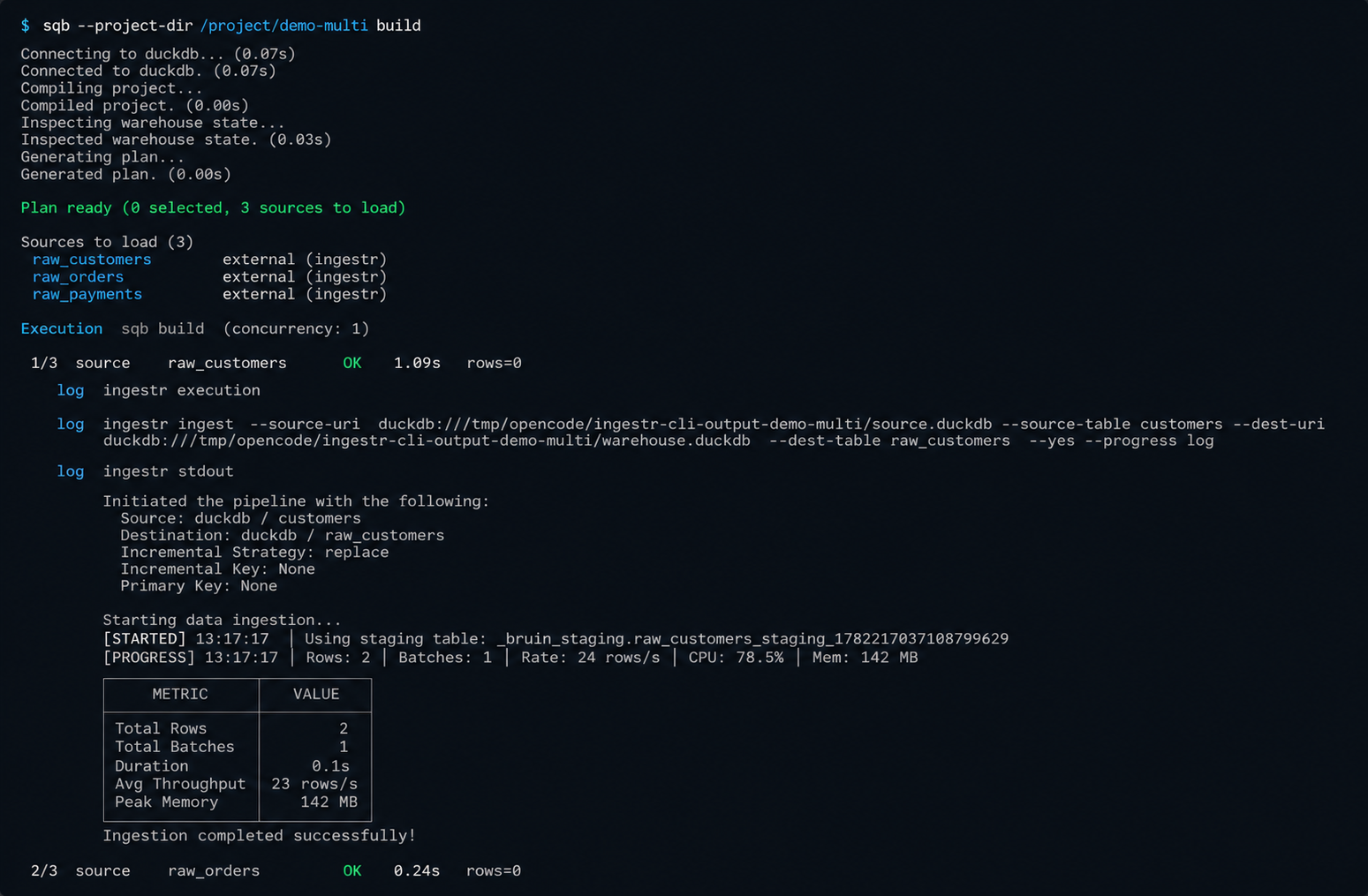
Example: PostgreSQL to DuckDB
Section titled “Example: PostgreSQL to DuckDB”Replicate a table from PostgreSQL into your local DuckDB project:
sources: - name: raw_orders table: orders ingestr: source_uri: "postgresql://user:pass@host:5432/mydb" source_table: "public.orders"That’s it. Run sqb load or sqb build and ingestr copies the orders table into your project.
Example: Stripe with incremental merge
Section titled “Example: Stripe with incremental merge”Load Stripe charges with incremental merge on a primary key:
sources: - name: raw_stripe_charges table: charges ingestr: source_uri: "stripe://${stripe_api_key}" source_table: "charges" strategy: merge primary_key: id incremental_key: createdOn subsequent runs, ingestr merges new and updated records based on the id column, using created to detect changes.
Configuration reference
Section titled “Configuration reference”The ingestr block on a source supports the following fields:
| Field | Required | Description |
|---|---|---|
source_uri |
Yes | ingestr source connection URI (e.g. postgresql://..., stripe://..., shopify://...) |
source_table |
Yes | Source table or resource name to ingest |
strategy |
No | Ingestion strategy: replace, append, merge, delete+insert, or truncate+insert |
incremental_key |
No | Column used for incremental change detection |
primary_key |
No | Primary key column(s) for merge strategy (string or list) |
columns |
No | Comma-separated column list to select from the source |
extra_args |
No | Additional CLI arguments passed to ingestr ingest (list of strings) |
Strategy mapping
Section titled “Strategy mapping”| Strategy | Behavior |
|---|---|
replace |
Drop and recreate the destination table (default when no strategy is set) |
append |
Insert all rows without deduplication |
merge |
Upsert based on primary_key, using incremental_key for change detection |
delete+insert |
Delete matching rows by incremental_key range, then insert replacements |
truncate+insert |
Truncate destination table, then insert all rows |
Template variables
Section titled “Template variables”All string fields in the ingestr block support SQLBuild project variable substitution and context templates:
sources: - name: raw_orders ingestr: source_uri: "postgresql://${pg_user}:${pg_password}@${pg_host}:5432/${pg_database}" source_table: "public.orders"Variables are resolved from the project’s merged variable config (project + target + local).
Set sensitive values in sqlbuild_local.toml (gitignored):
[vars]pg_user = "readonly"pg_password = "secret"pg_host = "prod-db.example.com"pg_database = "analytics"stripe_api_key = "sk_live_..."Destination URI
Section titled “Destination URI”SQLBuild automatically builds the ingestr destination URI from your adapter connection config. All supported adapters work without manual destination configuration:
| Adapter | Destination URI format |
|---|---|
| DuckDB | duckdb:///path/to/db.duckdb |
| MotherDuck | motherduck://database |
| PostgreSQL | postgresql://user:pass@host:port/db |
| Snowflake | snowflake://user:pass@account/db/schema |
| BigQuery | bigquery://project |
| Databricks | databricks://token:...@host |
| SQL Server | mssql://user:pass@host:port/db |
Reload
Section titled “Reload”When --reload is passed, ingestr runs with --full-refresh, forcing a complete reload regardless of the configured strategy:
sqb load --reloadsqb build --reloadBuild integration
Section titled “Build integration”ingestr sources are managed sources - they participate in the same lifecycle as Python loaders:
# ingestr runs automatically before dependent modelssqb build
# run ingestr sources standalonesqb load
# skip loadingsqb build --no-load
See Loaders for details on auto-load behavior, source deferral, and the --load / --no-load / --reload flags.
Supported sources
Section titled “Supported sources”ingestr supports 50+ sources including databases, SaaS APIs, and file systems. See the ingestr documentation for the full list of supported sources and their URI formats.